This post is for all the new developers out there coming to the industry. Take a look at the Title of this post. Ok read it again. Ok Again. Alright now lets get going. I wanted to post something to all the new developers that come into the field of IT. I myself am not a veteran software engineer, i count a little over 4 years of experience. Wanted to share my thoughts about the new guys who come in. I see them and remember myself 4 years back and wanted to share some insights.
I often see new people who come in, fresh and pumped up to work. This is just great to see, reminds me when i was first entering the world of IT. Few things i noted which i myself was a victim back in the days are the ones i am going to go through within this post.
Learn
I see few people these days who just enter the field of IT and they expect to work on the latest technology, with the latest frameworks and what not. This is great and there should be that hunger for technology but i would like to point out that you will not always get the chance to work on a project with all the latest technology. You would probably blame the company for not adapting to the new trends. Ok take two steps back. Look at it from this angle. Before two to three years did we have all these awesome java script frameworks that we now have? No. So people adapted their own frameworks that fit their needs which runs perfectly fine and has being running fine for quite a few years. Now when you fall into a project like that, you will probably think why would i ever want to learn all these boring old things since i know the new stuff. Ok again take two steps back. Look at current frameworks. Dont just look at them, dive into the code and look. Do you see a slight similarity between that and the current code of what your company use?
See everything that is there currently is a development of what already existed. Learn what you might think as "old" technology because these are the foundation on what current frameworks are built upon. Just because they are old does not mean its useless.
A few interns joined our company recently. A very talented group i must say. One guy was seated next to me, so i was asking how everything was going for him so far. He says "everything is good but i sure wish that i did not have to understand other's code and just write my own code instead". He was on a maintenance project and was mostly involved in bug fixes and enhancements. What i told him was that you will in a majority of cases be reading other's code and some may be bad and others would be good quality code. But whats important here is that you get to learn what is meant by bad code and good code my looking at other's code. Just writing your own code will get you no where.
There are many other cases i would like to share but i do not want to lengthen this post much :) .. Ill probably break it down into sub posts in the time to come. Ok moving on to my next point,
Respect
As new people who enter the field of IT learn to always respect your seniors. That does not mean that you have to shake your head and agree on everything that they say or tell you to do. But dont think less of them just because they might know the latest technology that is out there or has just come out. Remember this, as you mature in this field you see many technology come and go. Some stick around and others fail. Maybe you like a certain new framework or language that has just come out, but just because your senior engineers do not want to incorporate it into the project does not mean they do not know that specific technology, it means that they with their experience often can judge if a certain technology is mature enough to adhere and incorporate.
I must say i was in a similar situation when i first started working. Fresh out of grad school i was excited about going to work and starting off with the cool technology i just learned. But alas non of the tech leads or senior engineers even want to know about a particular technology i was talking about. I was left with some mix emotions. Sad, frustrated, angry and many more. Now when i look back i can see that those guys were actually right on the money. Because those technology i was talking about actually never materialized and some of them were a failure.
Remember to always respect your seniors no matter what. Some of them might be wrong sometimes. But most of the time they are right. Learn from them. If they think something you say is not correct dont be silent and in your mind mark that senior person as an idiot or incompetent. Ask him/her why that is so and the reason behind it. You will get a rationale answer i guarantee. You might not understand it fully at that moment, but some day you will.
Triumph
Ok last point. For anyone who got to this point thank you for reading this post and bare with me,just few more lines to go :) ... Actually this is an ongoing thing and you cant just accomplish this and wash your hands clean. To excel in this industry i believe the points i highlighted above are very important. Always keep learning, and i do not mean just about IT. Read anything that interests you. My father always says reading is the best habit you can have. Dont just be a nerd on a PC 24x7. Enjoy life, go out, play some sport you love, spend some time with family and loved ones. These i believe are all important things that make the essence of life just beautiful and more meaningful.
Ok thats about it guys. I know the last part is a bit too profound but just wanted to get that in there too :) . Cheers guys.....
Wednesday, February 16, 2011


Wednesday, February 9, 2011
The problem i faced with jqGrid and IE
Ok first of all before i start let me say this was not a problem with jqGrid or IE. I just started using jqGrid (hats off to the development team for the comprehensive documentation) in one of my projects i do in my free time. All was going well and i tested it out in IE7/8,FF2/3 and chrome. But i made a common mistake of not testing it in IE 6. When i went to deploy this at the clients environment alas it was IE 6. And the page i was using the jqGrid loaded and showed the message
I was baffled as to what this was. Debugging code at the client's environment was a pain. So as a work around i installed firefox for the moment until i found out what the issue was.
Went home, fired up note pad ++ and google of course :) .. in one site it mentioned that this could be the cause of a child element trying to modify a parent element. But i didnt find anything of such in my code.
In the path of an answer i saw that IE 8 was also giving the same error message but as a warning which didnt catch my eye. so i checked what that error was. it was as such;

Yikes now why didnt i see that first before my visit to the client. Oh well. So looking at the code, note that this was the only page that gave the problem and it was the only place where jqGrid was used. Looking at the DOM again i caught up with a code snippet of mine as such;
I saw the pager2 div didnt have a </div> element as i have just closed it within the same element it was defined. So hence i changed the following code as such;
Now im not sure why that is. I Googled about it but didnt find any results as to why that happens. Maybe if you guys know the answer please do leave by a comment which would be highly appreciated.
Hope this helps any other person who would face a similar situation.
Cheers and happy coding to all !!!!!
Internet Explorer cannot open the Internet site http://<web site="">.com. Operation aborted.
I was baffled as to what this was. Debugging code at the client's environment was a pain. So as a work around i installed firefox for the moment until i found out what the issue was.
Went home, fired up note pad ++ and google of course :) .. in one site it mentioned that this could be the cause of a child element trying to modify a parent element. But i didnt find anything of such in my code.
In the path of an answer i saw that IE 8 was also giving the same error message but as a warning which didnt catch my eye. so i checked what that error was. it was as such;

Yikes now why didnt i see that first before my visit to the client. Oh well. So looking at the code, note that this was the only page that gave the problem and it was the only place where jqGrid was used. Looking at the DOM again i caught up with a code snippet of mine as such;
<div style="padding:10px 0 0 30px;">
    <table id="list2"></table>
    <div id="pager2"/>
</div>
I saw the pager2 div didnt have a </div> element as i have just closed it within the same element it was defined. So hence i changed the following code as such;
<div style="padding:10px 0 0 30px;">
   <table id="list2"></table> <div id="pager2"></div>
   </div>
WAM!!! the bug dissapeared. So it seems that every div should be closed with a separate close div element rather than within the same opening tag although it doesnt have any content.
Now im not sure why that is. I Googled about it but didnt find any results as to why that happens. Maybe if you guys know the answer please do leave by a comment which would be highly appreciated.
Hope this helps any other person who would face a similar situation.
Cheers and happy coding to all !!!!!
Saturday, December 11, 2010
Technical innovation within a company, how do we approach it?
What does it mean to say technology innovation within the context of a company? Is it the the ability to create the next break through innovative project? Is it about creating the next best framework for development?
It can be so many things. But if you look at it, innovation should be looked at from the ground up approach. We cannot have technology innovation without first improving the skill levels of the existing and the newly joining developers within the company. True that only a few may be involved in creating the next best framework, but there should be proper processes in place so that newly joined people are given thorough knowledge on what goes on the inside of these frameworks.
I often meet people who uses highly optimized, efficient frameworks that are put together by people within a company using the current technologies working together pretty well. So i had a chat with this developer who was working in this project using this framework. This is how it went down;
Me : "Hey this looks pretty neat... How is this functionality handled within the framework?"
New guy : "Oh thats easy, i just put this entry to this file and it works just like that..."
Me: " :S ....."
Thats a puzzled face btw :) ... It was pretty clear that he/she had no idea what was going on in the inside of the framework. In the frameworks point of view this was great because it hides alot of complex details from the developer and handles it internally which is why we standardize good frameworks, but if you look at it from the companies perspective, now we have a few developers who just dont understand what goes on within the framework. So how is that a problem some might ask ( specially the management ;) ).
To the management its great because they see that any new developer can come in and start working on the project from day one which results in maximum efficiency right? WRONG.... If any issue comes up whilst working, they would have no ground knowledge to figure out where it is going wrong.
Im not saying that every developer should know in and out of the framework their project is working, but at least the high level understanding should be there so that when a problem arise, they will at least know where to start from to find the issue.
So how do we achieve this? When we start off with a particular framework for a project we should ask the main people involved in creating the framework to have a few slides explaining the high level details of why certain things were done the way they are in the current framework. And have at least a one day work shop organised for people who join newly to the respective project.This way the load on the technical leads will be less as they now have new people with a fare amount of knowledge on whats going on in the inside of the project which will prevent them from doing something radical which would break the whole concept of the framework.
And in terms of the company technology innovation has taken place, but this time its not just involving few people who develop the frameworks, but every one including the new people are included as part of the innovation. I believe innovation cannot happen unless the whole set of developers are inline with what we have achieved.
Innovation is a must in every IT company, in this post i just wanted to layout some basics that need to be in place for technical innovation to take place. If everyone knows where we are heading as a company then the path we should take is clear and transparent to everyone.
Wednesday, December 1, 2010
Plugin Based Architecture With Spring Integration
Introduction :
The purpose of this article is to demonstrate that it is possible to achieve a pluggable architecture using Spring Integration and the patterns it supports. If i were to give an introduction to Spring Integration it is a fairly new addition to the spring's solutions suite. It implements most of the Enterprise Integration Patterns currently known which makes it easier for developers as they do not need to re-invent the wheel. Some of the solutions provided by Spring Integration are as follows;
- Router
- Transformer
- Gateway
- Splitter
There are many more. As i am just getting my feet wet with Spring integration this is all i have covered up to now.
Pre-requisites :
In order to run this example you need the following jar files;
- com.springsource.org.aopalliance-1.0.0.jar
- commons-logging-1.1.1.jar
- spring-aop-3.0.3.RELEASE.jar
- spring-asm-3.0.3.RELEASE.jar
- spring-beans-3.0.3.RELEASE.jar
- spring-context-3.0.3.RELEASE.jar
- spring-context-3.0.5.RELEASE.jar
- spring-context-support-3.0.3.RELEASE.jar
- spring-core-3.0.3.RELEASE.jar
- spring-expression-3.0.3.RELEASE.jar
- spring-tx-3.0.3.RELEASE.jar
- spring-integration-core-2.0.0.RC2.jar
Note that i have used Spring 3.0.3 for this project. If you are using Spring 2.0 the required jars will be less. But as i used Spring Integration 2.0 i wanted to go with Spring 3.0.
Proposed Solution :
I have used the banking domain to demonstrate my example. The solution is to develop a system which will allows you to make payments to any banking system. The architecture is such that all code interfacing to any banking system is developed independently which can later be integrated to the main application as an when required. And you just have to inject the respective spring-integration config xml along with the plugin developed which can be injected to the project.
In this solution i have done it in the same code base but in real life the plugin development should be in a different module.
Implmentation :
First let me give you an overview diagram of the proposed solution;
In this solution i have done it in the same code base but in real life the plugin development should be in a different module.
Implmentation :
First let me give you an overview diagram of the proposed solution;
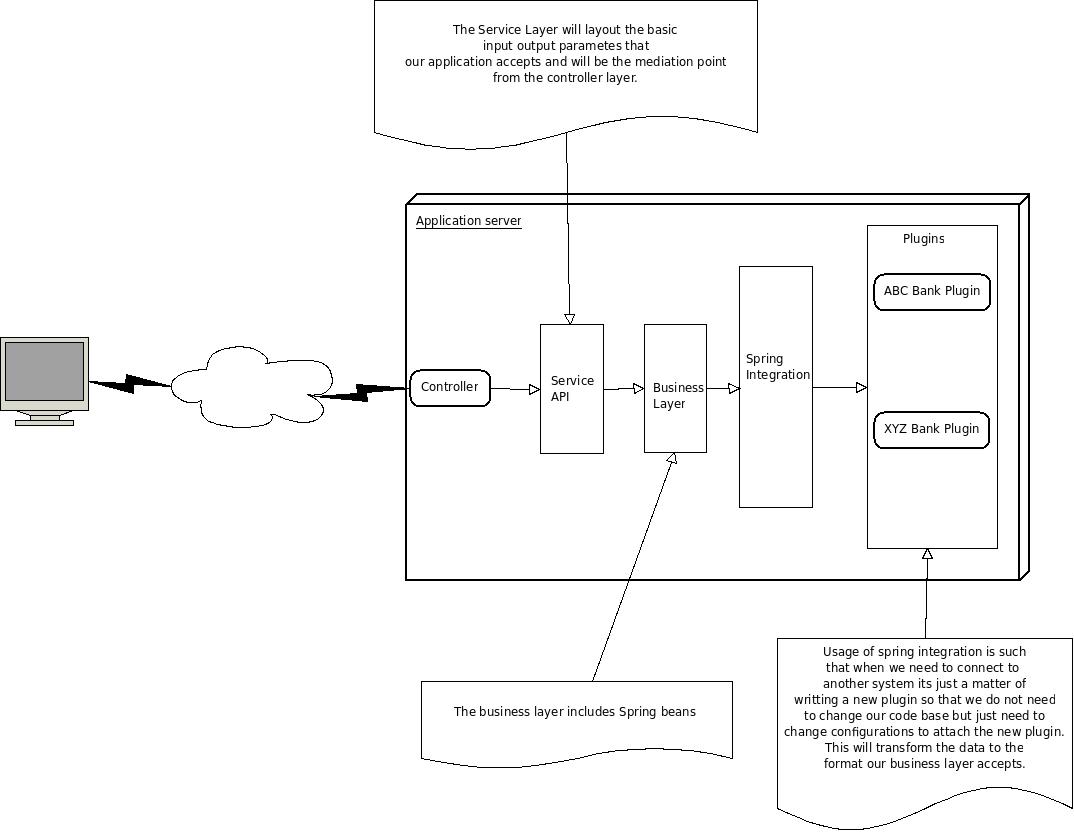
As you can see this is a typical architecture for a j2EE project. The controller i have specified here can be anything from struts to JSF to Spring MVC. The Service layer is basically the Spring layer which the controller will mainly be in contact with.
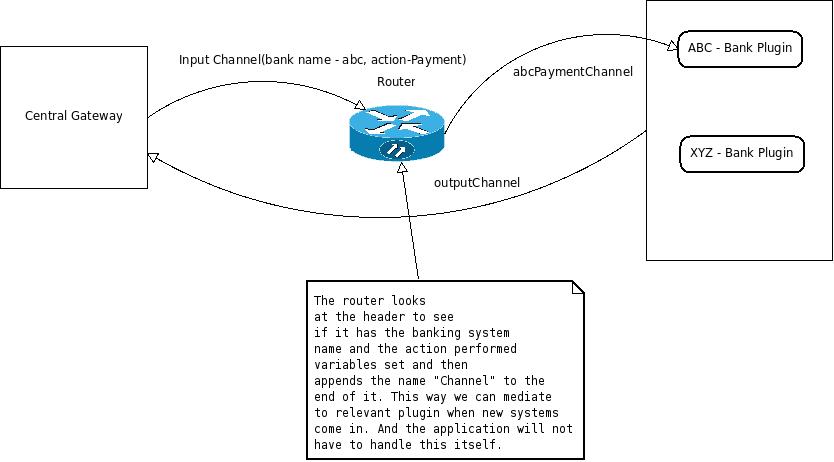
The main point to note is the spring integration layer. This is what injects all the plugins in the plugin repository. Next i will explain in detail the patterns of spring integration used in the solution. The following digram clearly explains this;

The main point to note is the spring integration layer. This is what injects all the plugins in the plugin repository. Next i will explain in detail the patterns of spring integration used in the solution. The following digram clearly explains this;


I will not go into detail on this digram as the diagram it self is self explanatory. So now lets get our hands dirty with some code;
First off i will start with the service layer;
package com.paymentgateway.services;

import com.paymentgateway.dto.PaymentRequestDTO;
import com.paymentgateway.dto.PaymentResponseDTO;

/**
 * The service interface is what the client from our application interacts with
 * the client is not aware of spring integration being used.
 *
 * @author dinuka
 */
public interface PaymentService {

    public PaymentResponseDTO makePayment(PaymentRequestDTO paymentRequestDTO);

}
package com.paymentgateway.services;

import java.util.HashMap;
import java.util.Map;

import org.springframework.beans.factory.annotation.Autowired;
import org.springframework.integration.message.GenericMessage;
import org.springframework.stereotype.Component;

import com.paymentgateway.dto.PaymentRequestDTO;
import com.paymentgateway.dto.PaymentResponseDTO;
import com.paymentgateway.dto.PaymentStatusCode;
import com.paymentgateway.dto.SystemActions;
import com.paymentgateway.gateway.CentralPaymentGateway;

@Component("paymentService")
public class PaymentServiceImpl implements PaymentService {

    @Autowired
    private CentralPaymentGateway gateway;

    @Override
    public PaymentResponseDTO makePayment(PaymentRequestDTO paymentRequestDTO) {
        /**
         * Here you can do any validation checks for null values if you need
         * and throw any relevant exception as needed. For simplicity purposes
         * i have not done so here.
         */

        /**
         * In the header we specify the banking system this message needs to be routed to<br>
         * Then in the
         */
        Map headerMap = new HashMap();
        headerMap.put("BANKING_SYSTEM", paymentRequestDTO.getBankingSystem());
        headerMap.put("ACTION", SystemActions.PAYMENT.toString());
        GenericMessage<PaymentRequestDTO> paymentRequestMsg = new GenericMessage<PaymentRequestDTO>(paymentRequestDTO,
                headerMap);
        PaymentResponseDTO paymentResponseDTO = gateway.makePayment(paymentRequestMsg);

        if (paymentResponseDTO.getStatusCode() == PaymentStatusCode.FAILURE) {
            /**
             * Throw relevant exception
             */
        }
        return paymentResponseDTO;

    }

}
And the DTOs used are as follows;
package com.paymentgateway.dto;

import java.io.Serializable;

/**
 * This DTO holds the data that needs to be passed to the
 * relevant plugin in order to make a payment
 *
 * @author dinuka
 */
public class PaymentRequestDTO implements Serializable {

    /**
     *
     */
    private static final long serialVersionUID = 582470760696219645L;

    /**
     * The account number of the customer
     */
    private String accountNumber;

    /**
     * The amount needed to be reduced
     */
    private Double deductAmount;

    /**
     * The First Name of the customer
     */
    private String firstName;

    /**
     * The Last Name of the customer
     */
    private String lastName;

    /**
     * This should ideally be moved to a CommonDTO as this will be reused by all
     * subsequent DTOs. Default banking system is "abc". The client needs to set
     * which banking system is needed to connect to.
     */
    private String bankingSystem = "abc";

    public String getAccountNumber() {
        return accountNumber;
    }

    public void setAccountNumber(String accountNumber) {
        this.accountNumber = accountNumber;
    }

    public Double getDeductAmount() {
        return deductAmount;
    }

    public void setDeductAmount(Double deductAmount) {
        this.deductAmount = deductAmount;
    }

    public String getFirstName() {
        return firstName;
    }

    public void setFirstName(String firstName) {
        this.firstName = firstName;
    }

    public String getLastName() {
        return lastName;
    }

    public void setLastName(String lastName) {
        this.lastName = lastName;
    }

    public String getBankingSystem() {
        return bankingSystem;
    }

    public void setBankingSystem(String bankingSystem) {
        this.bankingSystem = bankingSystem;
    }

    @Override
    public String toString() {
        return "PaymentRequestDTO [accountNumber=" + accountNumber + ", deductAmount=" + deductAmount + ", firstName="
                + firstName + ", lastName=" + lastName + "]";
    }

}
package com.paymentgateway.dto;

import java.io.Serializable;

/**
 * This is the default payment response DTO that every plugin
 * must return back to the system
 *
 * @author dinuka
 */
public class PaymentResponseDTO implements Serializable {

    /**
     *
     */
    private static final long serialVersionUID = 2773607380706313950L;

    /**
     * The account number of the customer
     */
    private String accountNumber;

    /**
     * The first name of the customer
     */
    private String firstName;

    /**
     * The last name of the customer
     */
    private String lastName;

    /**
     * The remaining balance in the account of the customer
     */
    private Double availableBalance;

    /**
     * The balance reduced from the customer account
     */
    private Double reducedBalance;

    /**
     * The status code indicating whether the transaction was a success or not
     */
    private PaymentStatusCode statusCode = PaymentStatusCode.SUCCESS;

    /**
     * The transaction id assigned to the relevant transaction
     */
    private Long transationId;

    public String getAccountNumber() {
        return accountNumber;
    }

    public void setAccountNumber(String accountNumber) {
        this.accountNumber = accountNumber;
    }

    public String getFirstName() {
        return firstName;
    }

    public void setFirstName(String firstName) {
        this.firstName = firstName;
    }

    public String getLastName() {
        return lastName;
    }

    public void setLastName(String lastName) {
        this.lastName = lastName;
    }

    public Double getAvailableBalance() {
        return availableBalance;
    }

    public void setAvailableBalance(Double availableBalance) {
        this.availableBalance = availableBalance;
    }

    public Double getReducedBalance() {
        return reducedBalance;
    }

    public void setReducedBalance(Double reducedBalance) {
        this.reducedBalance = reducedBalance;
    }

    public PaymentStatusCode getStatusCode() {
        return statusCode;
    }

    public void setStatusCode(PaymentStatusCode statusCode) {
        this.statusCode = statusCode;
    }

    public Long getTransationId() {
        return transationId;
    }

    public void setTransationId(Long transationId) {
        this.transationId = transationId;
    }

    @Override
    public String toString() {
        return "PaymentResponseDTO [accountNumber=" + accountNumber + ", firstName=" + firstName + ", lastName="
                + lastName + ", availableBalance=" + availableBalance + ", reducedBalance=" + reducedBalance
                + ", statusCode=" + statusCode + ", transationId=" + transationId + "]";
    }

}
package com.paymentgateway.dto;

/**
 * The status codes returned from each plugin indicating
 * if the transaction was a success or not
 *
 * @author dinuka
 */
public enum PaymentStatusCode {

    SUCCESS, FAILURE
}
package com.paymentgateway.dto;

import com.paymentgateway.util.PaymentRouter;

/**
 * This enum defines the system wide actions
 * We use this name in our {@link PaymentRouter}
 * to decide which channel to route the message
 *
 * @author dinuka
 */
public enum SystemActions {

    PAYMENT {
        @Override
        public String toString() {

            return "Payment";
        }
    }
}
Those are the DTOs i have used. Moving on, as the second diagram above specified we have defined a Central Gateway & A Router. So lets see how we have implemented those using spring integration;
package com.paymentgateway.gateway;

import org.springframework.integration.message.GenericMessage;

import com.paymentgateway.dto.PaymentRequestDTO;
import com.paymentgateway.dto.PaymentResponseDTO;

/**
 * This interface represents the common gateway which
 * will be used by Spring Integration to wire up the plugins
 * and also will be the central and first point of contact
 * by any client calling our business layer
 *
 * @author dinuka
 */
public interface CentralPaymentGateway {

    /**
     * This method takes a parameter type of {@link GenericMessage} which wraps<br>
     * an instance of {@link PaymentRequestDTO}. Usage of sending an instance of<br>
     * Generic Message is so that we can add header values which can indicate<br>
     * which banking system to call to
     *
     * @param paymentRequestDTO
     * @return
     */
    public PaymentResponseDTO makePayment(GenericMessage<PaymentRequestDTO> paymentRequestDTO);
}
Note that the gateway is just an interface defining our input parameters. We have used the GenericMessage defined by Spring integration. If you go back to the service layer implementation you can see that we have populated an instance of GenericMessage with the relevant DTO which is passed onto the gateway. The gateway here acts as a mediation layer.
Moving on with the Router implementation;
package com.paymentgateway.util;

import org.springframework.integration.Message;

/**
 * This is the base Router for All payment related functions
 * We route the message based on the banking system and the action
 * which comes in the header of the message. Ofcourse we can enhance this
 * to put the message on an error queue if the {@link Message} does not have the
 * relevant header values.
 *
 * @author dinuka
 */
public class PaymentRouter {

    public String resolveBankChannel(Message message) {
        return (String) message.getHeaders().get("BANKING_SYSTEM") + (String) message.getHeaders().get("ACTION")
                + "Channel";
    }
}
Again if you go back to the PaymentServiceImpl class you can see we set the two headers BANKING_SYSTEM and ACTION. The router decides which channel this message should go on. You can see this in the next section when we wire up all this together.
The Spring configurations are as follows;
First off i present to you the main config file named context-config.xml. This mainly injects the service layer beans.
<?xml version="1.0" encoding="UTF-8"?>
<beans xmlns="http://www.springframework.org/schema/beans"
 xmlns:xsi="http://www.w3.org/2001/XMLSchema-instance"
 xmlns:context="http://www.springframework.org/schema/context"
 xsi:schemaLocation="http://www.springframework.org/schema/beans http://www.springframework.org/schema/beans/spring-beans-3.0.xsd
  http://www.springframework.org/schema/context http://www.springframework.org/schema/context/spring-context-3.0.xsd">

 <context:component-scan base-package="com.paymentgateway.services" />
 <context:annotation-config />
</beans>
Next we look at the core configuration where we wire up the Spring Integration related components;
spring-integration-config.xml
<?xml version="1.0" encoding="UTF-8"?>
<beans xmlns="http://www.springframework.org/schema/beans"
 xmlns:xsi="http://www.w3.org/2001/XMLSchema-instance" xmlns:int="http://www.springframework.org/schema/integration"
 xsi:schemaLocation="http://www.springframework.org/schema/beans http://www.springframework.org/schema/beans/spring-beans-3.0.xsd
  http://www.springframework.org/schema/integration http://www.springframework.org/schema/integration/spring-integration-2.0.xsd">

 <!-- The generic input channel which would be used to pass through all messages
  coming into the Central Gateway -->
 <int:channel id="inputChannel"></int:channel>

 <!-- Here we wire up the Central Gateway which is the central point of access
  from our service layer -->
 <int:gateway id="gateway" default-request-channel="inputChannel"
  service-interface="com.paymentgateway.gateway.CentralPaymentGateway"
  default-reply-channel="outputChannel"></int:gateway>


 <!-- This is the generic Output channel which will be used by to send the
  output from any plugin. -->
 <int:channel id="outputChannel"></int:channel>

 <!-- The router is the one who decides which channel to send the message
  passed in from input channel into. The client should send the name of the
  Banking system where by 'SearchChannel' keyword is appended by the defaultRouter
  bean. -->
 <int:router id="centralRouter" ref="defaultRouter" method="resolveBankChannel"
  input-channel="inputChannel"></int:router>

 <bean id="defaultRouter" name="defaultRouter"
  class="com.paymentgateway.util.PaymentRouter" />


</beans>
That is the core configuration which wires up the Gateway, Router and defines the Channels required by the application. Next off lets go into our plugin( of many plugins to come) the ABC Bank Plugin.
First we define the Base plugin interface which all plugin developers should adhere to;
package com.paymentgateway.plugins;

import com.paymentgateway.dto.PaymentRequestDTO;
import com.paymentgateway.dto.PaymentResponseDTO;

/**
 * This is the base plugin interface. All plugin developers should adhere to<br>
 * this interface when they write new plugins connecting to different banking<br>
 * systems.
 *
 * @author dinuka
 */
public interface BasePlugin {

    public PaymentResponseDTO makePayment(PaymentRequestDTO paymentRequestDTO);

}
And the implementation of this interface is as follows;
package com.paymentgateway.plugins;

import com.paymentgateway.dto.PaymentRequestDTO;
import com.paymentgateway.dto.PaymentResponseDTO;
import com.paymentgateway.dto.PaymentStatusCode;

/**
 * This is the plugin used to connect to the ABC banking system
 * in order to do the payment transaction.
 *
 * @author dinuka
 */
public class ABCBankPlugin implements BasePlugin {

    @Override
    /**
     * Right now we just return a mock value. But when the true implementation
     * comes you will deal with any connection rellated information
     * at this point.
     */
    public PaymentResponseDTO makePayment(PaymentRequestDTO paymentRequestDTO) {
        PaymentResponseDTO paymentResponseDTO = new PaymentResponseDTO();
        paymentResponseDTO.setAccountNumber("abc123");
        paymentResponseDTO.setAvailableBalance(10000d);
        paymentResponseDTO.setFirstName("Dinuka");
        paymentResponseDTO.setLastName("Arseculeratne");
        paymentResponseDTO.setReducedBalance(500d);
        paymentResponseDTO.setStatusCode(PaymentStatusCode.SUCCESS);
        paymentResponseDTO.setTransationId(1233424234l);
        return paymentResponseDTO;
    }

}
As this is just a mock implementation i have just returned the response DTO with values filled. Now that we have developed our plugin lets wire it up;
abc_bank_plugin-config.xml
<?xml version="1.0" encoding="UTF-8"?>
<beans xmlns="http://www.springframework.org/schema/beans"
 xmlns:xsi="http://www.w3.org/2001/XMLSchema-instance" xmlns:int="http://www.springframework.org/schema/integration"
 xsi:schemaLocation="http://www.springframework.org/schema/beans http://www.springframework.org/schema/beans/spring-beans-3.0.xsd
  http://www.springframework.org/schema/integration http://www.springframework.org/schema/integration/spring-integration-2.0.xsd">

 <!-- Start of ABC Banking System Plugin Injection -->

 <!-- This is the payment channel used for the ABC banking system -->
 <int:channel id="abcPaymentChannel"></int:channel>

 <!-- Wire up the ABC Banking plugin -->
 <bean id="abcBakingSysPlugin" name="abcBakingSysPlugin"
  class="com.paymentgateway.plugins.ABCBankPlugin" />

 <!-- This service activator is used to handle the payment response from
  ABC banking system -->
 <int:service-activator input-channel="abcPaymentChannel"
  ref="abcBakingSysPlugin" method="makePayment" output-channel="outputChannel"></int:service-activator>

 <!-- End of ABC Banking System Plugin Injection -->
</beans>
And lastly i present a test class just so that you can run the solution given above;
package com.paymentgateway.test;

import org.springframework.context.ApplicationContext;
import org.springframework.context.support.ClassPathXmlApplicationContext;

import com.paymentgateway.dto.PaymentRequestDTO;
import com.paymentgateway.dto.PaymentResponseDTO;
import com.paymentgateway.services.PaymentService;

/**
 * This is a test class showing how it all comes together
 *
 * @author dinuka
 */
public class TestBankingApp {

    public static void main(String[] args) {
        ApplicationContext context = new ClassPathXmlApplicationContext("context-config.xml",
                "spring-integration-config.xml","abc_bank_plugin-config.xml");

        PaymentService paymentService = (PaymentService) context.getBean("paymentService");

        PaymentRequestDTO paymentRequestDTO = new PaymentRequestDTO();
        PaymentResponseDTO paymentResponseDTO = paymentService.makePayment(paymentRequestDTO);

        /**
         * We just print out the resulting DTO returned from the plugin<br>
         * as this is just a tutorial
         */
        System.out.println(paymentResponseDTO);
    }
}
Thats it. Your done with your plugin architecture. If you ever do develop another plugin all you have to do is implement the BasePlugin Interface and as well as give the wiring up spring file. The following diagram explains the flow in which the message travels which will give you an even clearer picture of what we have accomplished;
Future Enhancements:
- Implement a transformer pattern which will do the conversion of DTOs to application specific DTOs.
- Introduce an error channel where any error populated will be put in to.
Thats it guys. Your comments and suggestions are most welcome.
References:
[1] http://static.springsource.org/spring-integration/docs/2.0.0.RELEASE/reference/htmlsingle/
Friday, November 26, 2010
SQL with Hibernate Criteria
Hibernate's Criteria is a very comprehensive API which provides the user alot of flexibility to write dynamic queries. But of course nothing is perfect. I came across a situation where i had to truncate a date field in order to get the correct result set without considering the time portion. While going through the Criteria API I did not find anything which allowed me to do this. And hence in the path for a solution i found out that Criteria allows for plain SQL syntax to be included which i thought was a big plus point because it gives the developer the flexibility without restricting him/her just to the API.
The following code depicts the way you can incorporate plain SQL to your criteria API.
As you can see the Criteria API allows to put any valid SQL within the Restrics.sqlRestriction() method. Here i have used the trunc function.
Thats it. If you have any queries or suggestions pls do leave a comment.
Cheers!!!!
DetachedCriteria testCirteria = DetachedCriteria.forClass(Employee.class);
 SimpleDateFormat dateFormatForSearch = new SimpleDateFormat("dd/MM/yyyy");
 Calendar joinDate = empSearchDTO.getJoinDate();

  if (joinDate != null) {
      /**
 The following uses DateUtils of apache commons to truncate the<br>
 date object.
      **/
      joinDate = DateUtils.truncate(joinDate, Calendar.DATE);
      String dateAsStr = dateFormatForSearch.format(joinDate.getTime());
      testCirteria.add(Restrictions.sqlRestriction("trunc(emp_join_date)=to_date('" + dateAsStr + "','dd/mm/yyyy')"));

   }
As you can see the Criteria API allows to put any valid SQL within the Restrics.sqlRestriction() method. Here i have used the trunc function.
Thats it. If you have any queries or suggestions pls do leave a comment.
Cheers!!!!
Sunday, November 21, 2010
Why the saying "If all you have is a hammer then everything looks like a nail" is so true in the IT industry
"If all you have is a hammer then everything looks like a nail" - Now do not ask me who quoted this or from where i found it.. I vaguely remember seeing it on one of my buddies gtalk status some time back. But the reality of this statement struck me a week back.
We had got this new project in our company. Not a major high scale project. But involved some calculations. Was very interesting. Our company has a few frameworks developed around the years which is used as best practice for many projects. When our architect got this project he without even considering the architectural perspective of the project put in an already existing framework to start development.
Note that this was a project that involved just two(three including the login page) pages. But the technologies included in the framework were as follows;
We had got this new project in our company. Not a major high scale project. But involved some calculations. Was very interesting. Our company has a few frameworks developed around the years which is used as best practice for many projects. When our architect got this project he without even considering the architectural perspective of the project put in an already existing framework to start development.
Note that this was a project that involved just two(three including the login page) pages. But the technologies included in the framework were as follows;
- EJB 3.0
- JMS
- Spring
- Hibernate
- Freemarker
- Jasper
- Struts 2.0
and a few others which i cannot recall at this moment. And i was thinking to my self from all these what we actually needed to do this project. And this was all bundled up into an EAR which came to a size of a thumping 30MB :S... I was amazed at why such a person with so many years of experience would go for such an inappropriate solutions. Of course looking at it from his perspective im sure the higher management would have given him ridiculously tight dead lines to finish the project which lead him into jumping to an existing framework. And also this project was under a maven build. I mean come on, to build a freaking 3 page module it takes around 2mins because of all the dependent modules existing in the framework which is almost always never ever going to be used within this project. Talk about time waste.
In my opinion my technology stack for this project would have been using a simple ANT build using Spring to wire up and handle transactions with Hibernate and struts to handle the mediation layer and bundle it up as a WAR. Ofcourse some time back i did a solution where all the commonly used JARs were bundled up in a single jar which was deployed only once(Note that we use JBoss A/S as our application servers). This is because if you really look at it, the project it self is only a few MBs of size. But what takes most of the space is the third party libraries we use. This solution lead to lesser deployment time because else it takes alot of time to do a remote deployment to the servers if the file size is large.
The fact lies with why we cant think beyond what already exists. To think the same framework works in all situations is like thinking one antibiotic will cure all viruses. Of course time lines are an essential component. But if you really look at it, using the right tool for the right job will help you finish up the job with time to spare rather than using an existing framework and removing all parts which you do not need which is both time consuming and error prone.
So my theory is dont have just a hammer, but have a tool kit with various options under your belt which will serve you and your team mates better where by will be better for your company as well.
Friday, October 29, 2010
XML Parsing with AXIOM
Recently a friend of mine inquired about what the best way is to parse XML. I have to say im not an expert in this subject but from what i have read i instantly remembered that AXIOM is a pull parser which means that when you request for a particular element within your XML document push parsers will give you that exact element where as other pull parsers will build the whole XML document before handing over the relevant document element to you. Hence AXIOM will leave the least memory foot print.
The problem was i could not find a clear and concise tutorial explaining how to deal with XML using AXIOM. After playing around with it i figured out how to manipulate XML with AXIOM which i should say is so much better that the cumbersome code you have to deal with when manipulating with DOM or JDOM.
So following i show a simple example of how to manipulate XML with AXIOM;
First off i present the XML i will be parsing
Next i wrote a factory method to handout StaxBuilder instances depending on the XML file you pass. I have done as such so as to minimize the task of creating new StaxBuilder instances everytime.
I have used a Concurrent Hash map so that this wil work well in a multi threaded application. If your not bothered with that you might as well use a normal HashMap for better performance which in this case would be negligible. I have also used a custom exception as i did not want the user to have to handle exceptions so i wrapped the exceptions thrown to my custom run time exception. Following is that code. Nothing major just a normal extension of the RuntimeException class;
Next off i have written a utility class to deal with the XML parsig. Ofcourse this is not needed but i just had it so that client calls will be much cleaner without having to deal with XML releated coding which would be abstracted by the utility class. Note -The current method only reads the root level elements passed in.
And finally i give to you a sample class to test out the XML parsing example i have presented to you here.
Thats it. If you have any queries or any improvement points you see pls do leave a comment which would be highly appreciated. Hope this helps anyone out there looking for a similar basic tutorial on AXIOM XML parsing.
Cheers
The problem was i could not find a clear and concise tutorial explaining how to deal with XML using AXIOM. After playing around with it i figured out how to manipulate XML with AXIOM which i should say is so much better that the cumbersome code you have to deal with when manipulating with DOM or JDOM.
So following i show a simple example of how to manipulate XML with AXIOM;
First off i present the XML i will be parsing
<?xml version="1.0" encoding="utf-8" ?>
<my_servers>
 <server>
  <server-name>PROD</server-name>
  <server-ip>xx.xx.xx.xx</server-ip>
  <server-port>80</server-port>
  <server-desc>Running A/S</server-desc>
 </server>

 <server>
  <server-name>PROD2</server-name>
  <server-ip>xx1.xx1.xx1.xx1</server-ip>
  <server-port>80</server-port>
  <server-desc>Running A/S</server-desc>
 </server>
</my_servers>
Next i wrote a factory method to handout StaxBuilder instances depending on the XML file you pass. I have done as such so as to minimize the task of creating new StaxBuilder instances everytime.
import java.io.FileInputStream;
import java.io.FileNotFoundException;
import java.util.Map;
import java.util.concurrent.ConcurrentHashMap;

import javax.xml.stream.XMLStreamException;

import org.apache.axiom.om.impl.builder.StAXOMBuilder;

public class AxiomStaxBuilderFactory {

    private static Map<String, StAXOMBuilder> staxBuilderMap = new ConcurrentHashMap<String, StAXOMBuilder>();

    /**
     * The factory method stores the {@link StAXOMBuilder} instance created for each XML file<br>
     * passed in so that we do not need to create unnecessary objects every time.<br>
     * An instance of {@linkplain ConcurrentHashMap} is used so as to make the<br>
     * instances thread safe.
     *
     * @param xmlFilePath the path of the XML file
     * @return an instance of the {@link StAXOMBuilder} from the cache or newly created
     */
    public static StAXOMBuilder getAxiomBuilderForFile(String xmlFilePath) {
        StAXOMBuilder staxBuilder = null;
        if (staxBuilderMap.containsKey(xmlFilePath)) {
            staxBuilder = staxBuilderMap.get(xmlFilePath);
        } else {
            try {
                staxBuilder = new StAXOMBuilder(new FileInputStream(xmlFilePath));
                staxBuilderMap.put(xmlFilePath, staxBuilder);
            } catch (FileNotFoundException e) {
                throw new AxiomBuilderException(e);
            } catch (XMLStreamException e) {
                throw new AxiomBuilderException(e);
            }
        }

        return staxBuilder;

    }
}
I have used a Concurrent Hash map so that this wil work well in a multi threaded application. If your not bothered with that you might as well use a normal HashMap for better performance which in this case would be negligible. I have also used a custom exception as i did not want the user to have to handle exceptions so i wrapped the exceptions thrown to my custom run time exception. Following is that code. Nothing major just a normal extension of the RuntimeException class;
/**
 * This exception class wraps all exceptions thrown from the Axiom API
 * as the user does not need to be bound by such checked exceptions.
 * @author dinuka
 *
 */
public class AxiomBuilderException extends RuntimeException {

    /**
     *
     */
    private static final long serialVersionUID = -7853903625725204661L;

    public AxiomBuilderException(Throwable ex) {
        super(ex);
    }

    public AxiomBuilderException(String msg) {
        super(msg);
    }
}
Next off i have written a utility class to deal with the XML parsig. Ofcourse this is not needed but i just had it so that client calls will be much cleaner without having to deal with XML releated coding which would be abstracted by the utility class. Note -The current method only reads the root level elements passed in.
import java.util.ArrayList;
import java.util.HashMap;
import java.util.Iterator;
import java.util.List;
import java.util.Map;

import javax.xml.namespace.QName;

import org.apache.axiom.om.OMElement;
import org.apache.axiom.om.impl.builder.StAXOMBuilder;

/**
 * The utility class provides abstraction to users so that <br>
 * the user can just pass in the xml file name and the node he/she<br>
 * wants to access and get the values without having to bother with<br>
 * boilerplate xml handling info.
 *
 * @author dinuka
 */
public class AxiomUtil {

    /**
     * This method is used if you have for example a node with multiple children<br>
     * Note that this method assumes the node in query is within the root element
     *
     * @param xmlFilePath the path of the xml file
     * @param nodeName the node name from which you want to retrieve values
     * @return the list containing key value pairs containing the values of the sub elements within<br>
     *         the nodeName passed in.
     */
    public static List<Map<String, String>> getNodeWithChildrenValues(String xmlFilePath, String nodeName) {
        List<Map<String, String>> valueList = new ArrayList<Map<String, String>>();

        StAXOMBuilder staxBuilder = AxiomStaxBuilderFactory.getAxiomBuilderForFile(xmlFilePath);

        OMElement documentElement = staxBuilder.getDocumentElement();
        Iterator nodeElement = documentElement.getChildrenWithName(new QName(nodeName));

        while (nodeElement.hasNext()) {
            OMElement om = (OMElement) nodeElement.next();

            Iterator it = om.getChildElements();
            Map<String, String> valueMap = new HashMap<String, String>();
            while (it.hasNext()) {
                OMElement el = (OMElement) it.next();

                valueMap.put(el.getLocalName(), el.getText());

            }

            valueList.add(valueMap);
        }
        return valueList;
    }

}
And finally i give to you a sample class to test out the XML parsing example i have presented to you here.
import java.util.List;
import java.util.Map;

/**
 * Test class depicting the use of Axiom parsing XML
 *
 * @author dinuka
 */
public class testServerConfigXML {

    public static void main(String argv[]) {

        List<Map<String, String>> values = AxiomUtil.getNodeWithChildrenValues("/home/dinuka/serverInfo.xml", "server");

        for (Map<String, String> mapVals : values) {
            for (String keys : mapVals.keySet()) {
                System.out.println(keys + "=" + mapVals.get(keys));
            }
        }

    }

}
Thats it. If you have any queries or any improvement points you see pls do leave a comment which would be highly appreciated. Hope this helps anyone out there looking for a similar basic tutorial on AXIOM XML parsing.
Cheers
Subscribe to:
Posts (Atom)